
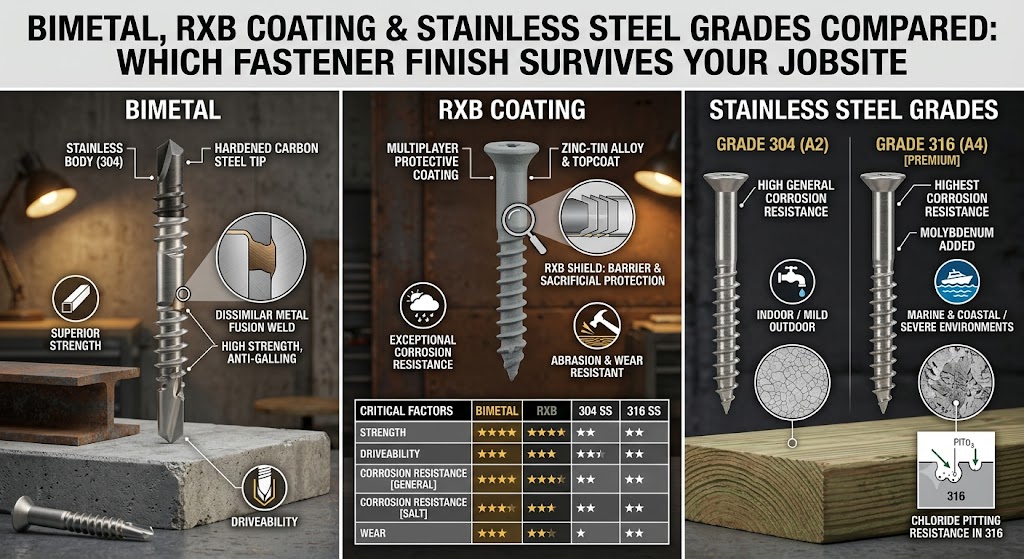
Selecting a fastener grade is only half the decision. The construction method — solid, bimetal, or coated — determines whether that screw lasts 2 years or 20 on site. Below is a straight-talking comparison of the three material families and two dominant coating systems that OEM buyers actually specify.
The Real-World Problem
Project failures rarely stem from choosing the wrong grade. They stem from a mismatch between the fastener's surface and its environment: a 410 self-driller rusting through its RXB layer in a chlorinated pool enclosure; a solid 304 screw stripping out because it cannot penetrate 1.2 mm steel decking; an HDG bolt whose zinc flakes jam a precision-threaded nut. Understanding the interaction between base metal + construction + coating is what separates a reliable spec from a warranty claim.
Stainless Steel Grades at a Glance
SS304 — The General-Purpose Workhorse
18 % Cr / 8 % Ni. Adequate corrosion resistance for most outdoor and mildly corrosive settings — building facades, interior structural steel, rooftop HVAC. The most cost-effective austenitic grade. Limitation: prone to pitting in chloride concentrations above ~200 ppm (coastal splash zones, pool environments).
SS316 — The Chloride Fighter
Adds 2–3 % molybdenum. Pitting resistance equivalent (PRE) jumps from ~19 (304) to ~24. This is the minimum spec for marine splash zones, desalination plants, and chemical tank farms. Price premium over 304: typically 25–35 %. When to upgrade: any site within 3 km of saltwater or exposed to de-icing salts.
410 — The Hard-Drilling Martensitic
Heat-treatable to HRC 28–34. Enables self-drilling points that pierce steel up to 12 mm (depending on point geometry). Trade-off: corrosion resistance is significantly lower than austenitic grades — 410 fasteners must carry a protective coating for outdoor use. Indoor or dry-environment structural connections are the only bare-metal exception.
Bimetal Construction: Best of Both Worlds?
Bimetal (also called bi-metal or duplex) screws weld a 1022 carbon-steel drill point to an austenitic stainless-steel body (typically 304 or 316). The carbon-steel tip delivers drilling performance that solid stainless cannot match; the stainless shank provides corrosion resistance where it matters — the exposed thread and head.
Where Bimetal Excels
Metal roofing and cladding — drills through 0.5–1.5 mm steel sheets, stainless body resists weather exposure
Solar racking — penetrates galvanised steel substructures, survives 25-year field life
HVAC ductwork — self-pierces galvanised steel, no pre-drilling labour
Where Bimetal Falls Short
The weld seam between tip and body is a galvanic boundary. In continuous immersion or high-salt environments, prefer solid SS316. Bimetal is also not suitable for heavy structural bolting — stick to threaded rod or hex bolts in those applications.
Coating Systems: RXB vs Hot-Dip Galvanising
| Property | RXB Coating | Hot-Dip Galvanising (HDG) |
|---|---|---|
| Process | Dip-spin, organic-inorganic composite | Zinc bath immersion, 450 °C+ |
| Thickness | 15–25 µm | 45–85 µm |
| Salt-spray life (ASTM B117) | 500–1 000 h | 1 000–2 000+ h |
| Thread fit | Precision — no overbuild | Zinc can fill threads; may require over-tapping |
| Aesthetic | Uniform, coloured (blue / grey / black) | Spangled, rougher surface |
| Best use case | Self-drilling screws, timber screws, visible connections | Structural bolts, embedded anchors, underground |
| Cost tier | Mid | Mid–high (heavier zinc consumption) |
How to Choose Between RXB and HDG
If your fastener is a precision-threaded self-driller or timber screw where thread clearance and appearance matter, RXB is the right call. If you are specifying structural hex bolts, anchor bolts, or heavy-washer assemblies destined for concrete embedment or soil contact, HDG provides the sacrificial zinc mass that buys decades of service life.
Procurement Recommendations by Environment
| Environment | Recommended Fastener | Why |
|---|---|---|
| Inland construction (dry) | 410 + RXB self-drilling screw | Drilling power + adequate coating at lowest cost |
| Coastal / marine splash | SS316 bimetal self-driller or solid SS316 | Molybdenum resists chloride pitting; bimetal if drilling needed |
| Chemical / petrochemical | Solid SS316 hex bolt (HDG not suitable) | Zinc reacts with many process chemicals |
| Solar racking (general) | SS304 bimetal + RXB point | Drills steel, body resists UV & rain |
| Solar racking (coastal) | SS316 bimetal + RXB point | Upgraded body for salt spray |
| Underground / embedded | Carbon steel + HDG | Sacrificial zinc mass for long-term protection |
| Greenhouse / agricultural | 410 + RXB or HDG | Humidity + fertiliser exposure; RXB for screws, HDG for bolts |
Bottom Line for Buyers
Stop thinking in terms of "304 or 316" alone. The right question is: "What base metal + what construction + what coating matches my site's corrosion load and installation method?" A 410 self-driller with RXB outperforms a bare 304 screw in metal decking. A solid SS316 bolt outlasts any coated fastener in a desalination plant. The optimum spec sits at the intersection of three variables — not one.
EC Fastener manufactures 304/316/410 screws, bimetal self-drillers, timber screws, and RXB/HDG-coated fasteners under one roof — cold-forged, thread-rolled, and salt-spray tested before shipment. Request a quote or send your spec sheet to info@ecindustry.com.