

Latin America is in the midst of a historic power grid expansion.
Brazil alone plans over 15,000 km of new transmission lines through
2029. Chile, Colombia, and Peru are adding renewable energy corridors
that demand new high-voltage infrastructure. At every lattice tower,
at every angle connection, the structural integrity depends on one
component category: the transmission tower bolt.
This article covers the standards, materials, coatings, and
specification requirements for bolts used in high-voltage transmission
towers across South America.
STANDARDS: ABNT NBR 8800 vs ASTM vs ISO
Brazilian transmission towers are predominantly designed to ABNT NBR
8800 (the Brazilian structural steel design standard), which references
fastener requirements from:
- ABNT NBR 8800:2008 — Structural steel design (fastener section)
- ABNT NBR 7586 — Hex bolts for steel structures
- ABNT NBR 6628 — Galvanized hex nuts
- ABNT NBR 11576 — High-strength bolts for steel structures
In practice, many Brazilian EPCs and tower fabricators accept or
prefer ASTM equivalents:
| ABNT Standard | ASTM Equivalent | Application |
|---------------------|-----------------------|---------------------------|
| NBR 7586 | A325 / F3125 | Bearing-type connections |
| NBR 11576 | A490 / F3125 | Friction-type connections |
| NBR 6628 | A563 | Heavy hex nuts |
| — | F436 | Hardened washers |
For Chile, Colombia, and Peru, ASTM A394 (galvanized steel tower
bolts) is the dominant specification, supplemented by local
adaptations.
THE CRITICAL ROLE OF GALVANIZING
Transmission towers are exposed to the atmosphere for 40-50 years
without maintenance access to individual bolted connections. Hot-dip
galvanizing per ASTM A153 Class C (or ISO 1461) is mandatory:
- Minimum zinc coating thickness: 55 µm for bolts M10-M24
- The galvanizing must be continuous — no bare spots, no flaking
- Nuts must be overtapped after galvanizing to ensure assembly
A common field problem: zinc buildup in the thread roots prevents
nut run-down. The solution is controlled overtapping per ASTM A563
Appendix X4, with the nut retapped 0.016"-0.024" over the nominal
pitch diameter after galvanizing.
BOLT CONFIGURATIONS FOR LATTICE TOWERS
Transmission tower bolts follow specific configurations that differ
from standard structural bolting:
1. Square-neck bolt with hex nut (carriage bolt style)
— Head rotates into the angle leg, nut is torqued from the
opposite side. Prevents head rotation during tightening.
— Specified as "tower bolt" or "square-neck bolt"
— Common sizes: 5/8"-11 × 2" to 1"-8 × 6"
2. Hex bolt with hex nut
— Used where both sides are accessible
— Standard A325/A490 Type 1, galvanized
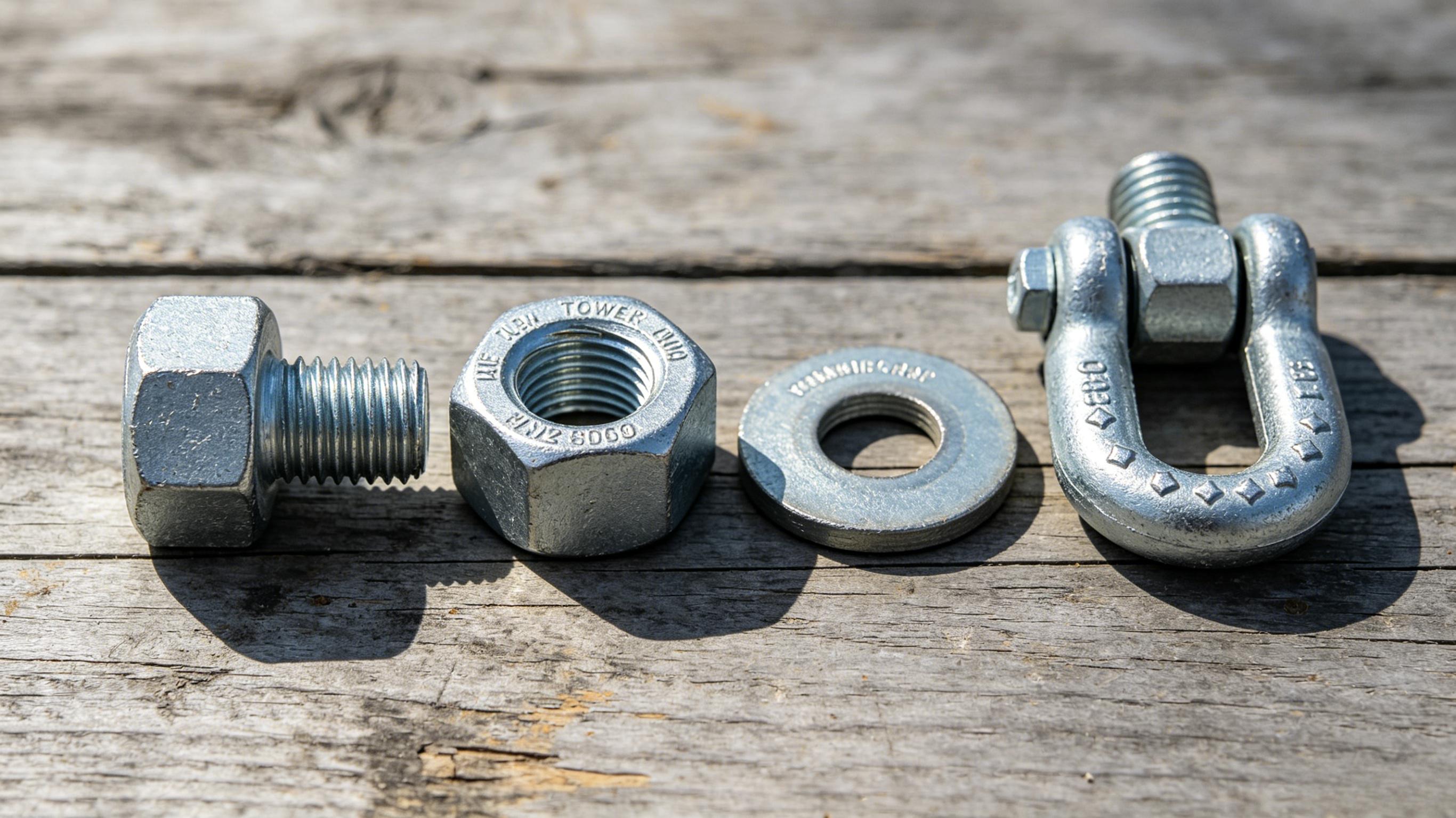
3. Eye bolt / clevis bolt
— Used at suspension points for conductor hardware
4. U-bolt
— Used to attach crossarm braces to the main leg
All tower bolts must be supplied with hardened washers (ASTM F436
Type 1, galvanized) under both the head and nut when connecting
galvanized angles.
MECHANICAL REQUIREMENTS
For the most common bearing-type connections on 69 kV-500 kV towers:
| Property | A325 (Grade 8.8 equiv.) | A490 (Grade 10.9 equiv.) |
|-----------------------|--------------------------|---------------------------|
| Tensile strength min | 827 MPa (120 ksi) | 1034 MPa (150 ksi) |
| Yield strength min | 660 MPa (95.7 ksi) | 895 MPa (130 ksi) |
| Proof load | 568 MPa (82.3 ksi) | 780 MPa (113 ksi) |
| Hardness (HRC) | 24-35 | 33-39 |
For friction-type (slip-critical) connections, the faying surfaces
must be prepared to achieve the required slip coefficient (typically
Class A: µ = 0.33 or Class B: µ = 0.50 per ASTM F3125 / RCSC
Specification). Galvanized faying surfaces must be roughened or
wire-brushed if slip-critical behavior is required.
FIELD INSTALLATION ISSUES
- Thread galling on galvanized bolts: Apply lubricant (wax or
oil-based) to the first 2-3 threads before nut installation.
- Over-torquing: Field crews often exceed specified torque on
tower bolts, especially with impact wrenches. Calibrated torque
verification is essential for slip-critical joints.
- Missing washers: Omitting the washer under a galvanized nut
can cause the nut to dig into the galvanized angle surface,
reducing clamp force and damaging the zinc coating.
- Bolt length errors: Tower bolts must project through the nut
by at least one full thread per ASTM F3125 — too short and
the connection is non-compliant.
SUPPLY CHAIN CONSIDERATIONS FOR LATAM
- Lead times for galvanized tower bolts are typically 10-14 weeks
from Asian suppliers, including galvanizing and inspection.
- Brazilian EPCs increasingly require local content certification
(BNDES FINAME compliance) — a barrier for import-only suppliers.
- For non-Brazil markets (Chile, Peru, Colombia), ASTM-spec
galvanized bolts from China are widely accepted and cost-
competitive against European sources.
- Packaging for sea freight: bolts and nuts must be separated
(not pre-assembled) and packed in HDG steel drums or wooden
crates with moisture barrier. Galvanized bolts arriving with
white rust (wet storage stain) will be rejected.
--------------------------------------------------------------------------
--------------------------------------------------------------------------
SPECIFICATION SUMMARY
Tower bolt spec: ASTM A394 / F3125 Type 1 (or NBR 7586/11576)
Galvanizing: ASTM A153 Class C / ISO 1461 (min 55 µm)
Nut spec: ASTM A563 DH (overtapped for galvanized)
Washer spec: ASTM F436 Type 1 (galvanized)
Slip-critical prep: Class A or B faying surface per RCSC
Design life: 40-50 years atmospheric exposure
If you are looking for high-quality fasteners, please visit our [Product Page] or [Contact Us] to get a quote.