
Part 1 — Meta Title
Tips to Prevent Wood from Splitting When Using Wood Screws (60 characters)
Part 2 — Meta Description
Wood screw prevent splitting — practical tips on pilot holes, screw size, lubrication, and driving technique to keep hardwood and softwood crack-free. (140 characters)
Part 3 — Full Article Content
Tips to Prevent Wood from Splitting When Using Wood Screws
Wood splitting is one of the most preventable problems in carpentry, furniture assembly, and pallet production. A single crack can scrap an expensive board, weaken a joint, and erode margins for both workshops and fastener distributors. In most cases, the failure traces back to a few correctable choices involving the fastener, the pilot hole, and the driving technique. This guide walks procurement teams, engineers, and construction workers through the methods that consistently deliver clean, crack-free fastenings on hardwood and softwood stock.
Why Wood Splits: The Mechanics Behind the Crack
Wood is anisotropic — its strength along the grain is several times higher than across it. When a wood screw is driven into a board, it generates radial pressure that pushes fibers apart. If that pressure exceeds the board's cross-grain tensile strength before the threads cut a path, the fibers separate and a split propagates from the insertion point.
The most common aggravating factors are an oversized shank acting as a wedge, an absent or undersized pilot hole, driving too close to the edge or end of the board, dense hardwoods with no thread lubrication, and dry aged lumber that has lost internal moisture. Each of these can be neutralized with a targeted preventive step in the next section.
Practical Methods to Prevent Splitting
1. Drill a Correctly Sized Pilot Hole
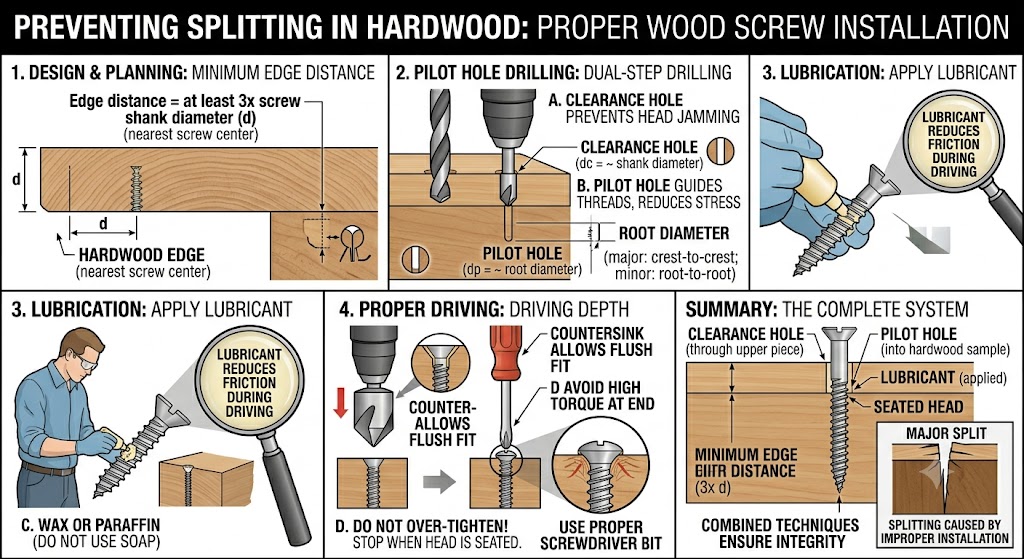
The single most effective technique. The pilot diameter should match the fastener's minor thread diameter — about 70% of the major diameter for softwood, 90% or more for dense species. For a 4 mm screw, a 3 mm pilot is typical in pine; in oak or beech, a 3.5 mm hole is safer. Standards such as DIN 97 and DIN 7997 publish recommended pilot diameters per size.
2. Add a Clearance Hole in the Top Board
When joining two boards, drill a clearance hole — equal to or slightly larger than the screw's major diameter — through the top piece. The threads then engage only the bottom board, eliminating the wedging effect above the joint. This is standard practice in cabinet making and fine furniture.
3. Choose the Right Screw Type and Size
Partially threaded wood screws pull the two boards together without pushing them apart — far kinder to the wood than a fully threaded fastener. Select a length that penetrates the bottom board by at least two-thirds of its thickness. For thin stock under 12 mm, switch to a smaller diameter rather than forcing a single oversized screw. A countersunk head with nibs helps the fastener self-seat and reduces lateral wobble.
4. Lubricate the Threads
A small amount of beeswax, paraffin, or soap on the threads reduces insertion torque significantly. Lower torque means lower radial pressure on the fibers, which directly reduces split risk — especially in dry hardwood. For high-volume production, factory-waxed wood screws deliver consistent results shift after shift.
5. Control Speed and Stop on Seating
Use a low-to-medium speed on a cordless drill or impact driver; high RPM generates heat that increases split risk. Stop the moment the head seats flush — over-driving compresses fibers beyond their elastic limit and cracks the surface. A torque-limiting clutch on an impact driver disengages at the preset setting and prevents the operator from sinking the head too deep.
6. Mind Edge Distance and Grain Direction
Keep the fastener at least two to three shank diameters from the edge and four to five from the end. Where possible, drive into the face (cross-grain) rather than the end grain — end grain splits far more easily. Near the end of a board, predrill and angle the screw slightly off perpendicular to reduce the chance of splitting along the grain line.
Summary
Wood screw splitting is rarely a fastener-quality problem — it is almost always a pilot-hole, screw-size, or driving-technique issue solvable in seconds. Drill a correctly sized pilot hole, add a clearance hole through the top board for joints, choose a partially threaded wood screw matched to the stock, lubricate the threads, and stop driving the moment the head seats. Apply these steps consistently, and your fastenings will be clean, strong, and crack-free.
As a specialized fastener manufacturer and exporter, we supply wood screws in slotted, Phillips, Pozi, Torx, and square-drive heads, plus partially threaded DIN 7997 styles in carbon steel, stainless steel, and brass. Custom thread lengths, head markings, and bulk packaging are available for wholesale buyers, importers, and OEM furniture manufacturers, with mixed-spec container shipments and small-MOQ trial orders supported.
Contact us today for a quotation, technical datasheets, or a free sample pack.