
Why Do Self-Drilling Screws Break During Installation?
Self-drilling screws integrate a drill point, thread-forming zone, and head into a single component — no pre-drilled pilot holes required. Unlike self-tapping screws, which need a pre-punched or drilled hole, self-drilling screws cut their own entry and form threads in one continuous operation. Yet a self-drilling screw broken during installation remains a common problem on construction sites and assembly lines. Each failure costs labor, wastes material, and may damage the workpiece. Identifying root causes helps contractors, engineers, and procurement teams reduce failure rates and improve installation reliability.
Common Causes of Self-Drilling Screw Failure
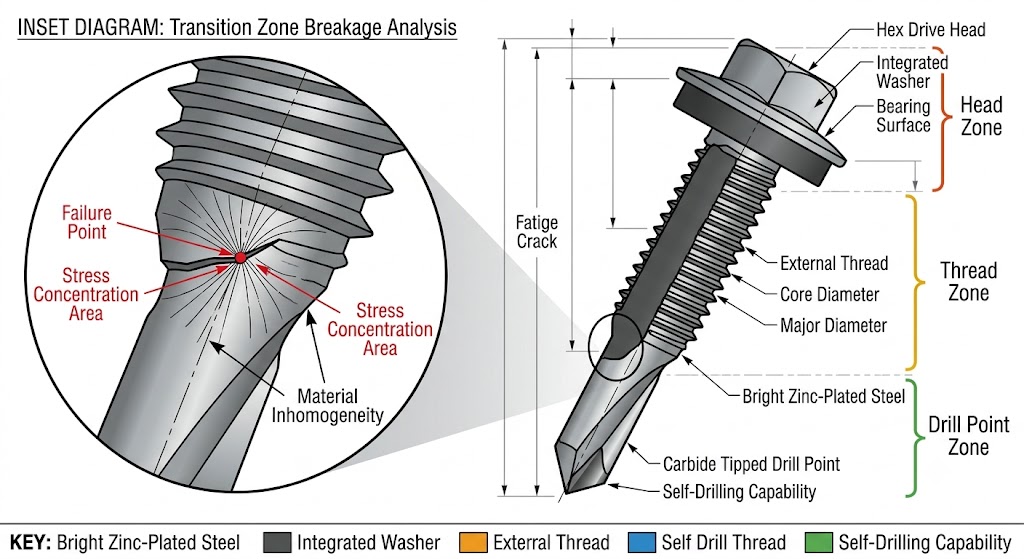
Drill Point Capacity Exceeded Every screw is rated for a specific drill point capacity — the maximum steel gauge it can penetrate. A #2 point handles approximately 2.5 mm; a #3 point reaches 4.5 mm. Driving into thicker material dulls the tip before breakthrough, and torque compensation shears the fastener at the drill-point-to-shank transition — the weakest cross-section. Always verify point capacity against substrate thickness.
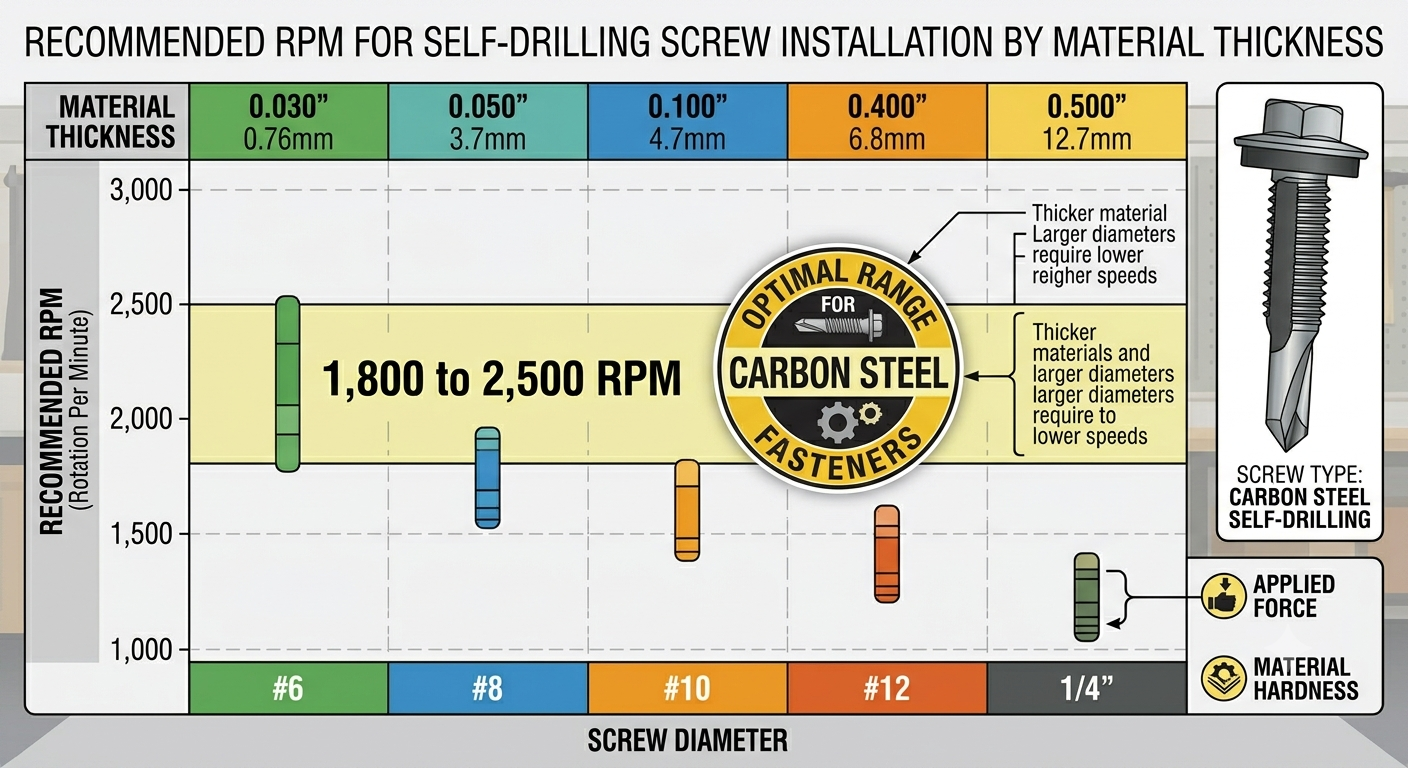
Excessive RPM and Heat Buildup Operating screwdrivers above 3,000 RPM generates friction heat that anneals the drill tip. The softened metal loses its cutting edge, binds, and snaps. Burn discoloration on the fracture surface reliably indicates heat-induced failure. For case-hardened carbon steel fasteners, the recommended driving speed is 1,800–2,500 RPM.
Workpiece Instability Unclamped or loosely secured sheet metal vibrates during the drilling phase, applying cyclic bending stress to the screw. This stress concentrates at the drill point root — the thinnest section of the fastener body — producing a clean shear break rather than a torsional twist-off. Firm clamping eliminates this lateral movement and ensures the screw penetrates perpendicular to the surface.
Substrate Hardness Mismatch Standard case-hardened screws are engineered for mild steel. Driving into hardened wear plates, high-tensile structural members, or double-layer stainless steel sheets rapidly destroys the drill tip — a broken screw is the expected outcome.
How to Prevent Screw Breakage During Installation
Select the Correct Fastener Specification Match the drill point number to the base metal thickness. For steel exceeding 3 mm, step up to #3 or #4 points. For stainless steel connections, bi-metal screws — a hardened carbon steel tip fusion-welded to a stainless steel shank — deliver drilling performance with corrosion resistance.
Calibrate Equipment Settings A depth-sensitive screw gun with adjustable torque clutch outperforms a standard impact driver. Set the depth stop so the head seats flush; over-driving stresses the head-underhead junction and can cause post-penetration snapping.
Control Speed and Add Lubrication Maintain driving speed within 1,800–2,500 RPM. When fastening steel thicker than 3 mm, apply a light cutting wax or lubricant to the drill tip. This reduces friction, lowers required driving torque, and measurably decreases the probability of a broken screw.
Verify Batch Quality Reliable performance demands consistent heat treatment. A properly case-hardened C1022 screw exhibits surface hardness of 450–550 HV with a case depth of 0.10–0.25 mm. Over-hardened screws become brittle; under-hardened ones strip. Request mill certificates to verify hardness profiles and chemistry per batch.
Summary
A self-drilling screw broken during installation is preventable: match drill point capacity to material thickness, control driving speed, clamp firmly, and source from manufacturers with documented QC. For demanding environments — coastal construction, stainless steel cladding, multi-layer roofing — bi-metal or premium-coated screws deliver optimal durability and installation reliability.
Fastener Supply — Wholesale & Custom Orders
We supply a full range of self-drilling screws, self-tapping screws, and custom fasteners to DIN, ISO, ASME, and IFI standards. Materials: carbon steel (C1022/C1018), stainless steel (A2/304, A4/316), and bi-metal, with zinc plating, Ruspert coating, or hot-dip galvanizing. OEM services cover head style, drill point geometry, thread pitch, and packaging — all shipments include material certifications.
For a product catalog, technical data sheets, or a tailored quotation, contact our sales team.