
When sourcing stainless steel fasteners, procurement teams face a recurring decision: 304 or 316? Both grades belong to the austenitic stainless steel family and share similar tensile strength (minimum 515 MPa under ISO 3506). Their corrosion resistance, however, differs significantly. Specifying the wrong grade leads to premature pitting, structural weakening, and costly on-site replacements. This article breaks down 304 vs 316 stainless steel screw differences across chemical composition, real-world performance, and total cost of ownership.
Chemical Composition: What Separates 304 from 316
The performance gap between these two grades starts at the metallurgical level. 304 stainless steel (UNS S30400, EN 1.4301) contains 18–20% chromium and 8–10.5% nickel as its primary alloying elements. 316 stainless steel (UNS S31600, EN 1.4401) shares the same chromium-nickel foundation but adds 2–3% molybdenum.
Molybdenum is the decisive factor. It forms a more stable passive oxide layer on the fastener surface, substantially improving resistance to pitting corrosion — the localized attack that creates small cavities on screw threads and under head bearing surfaces. For indoor machinery, furniture assembly, and general structural connections, 304 stainless steel screws deliver consistent performance at a competitive price point. When the environment introduces chlorides, however, the molybdenum content in 316 stainless steel fasteners directly translates into measurable gains in service life.
The PREN (Pitting Resistance Equivalent Number) formula — %Cr + 3.3 × %Mo + 16 × %N — yields ~18–20 for 304 and ~24–26 for 316, quantifying the corrosion resistance gap engineers observe in the field.
Corrosion Performance Across Application Environments
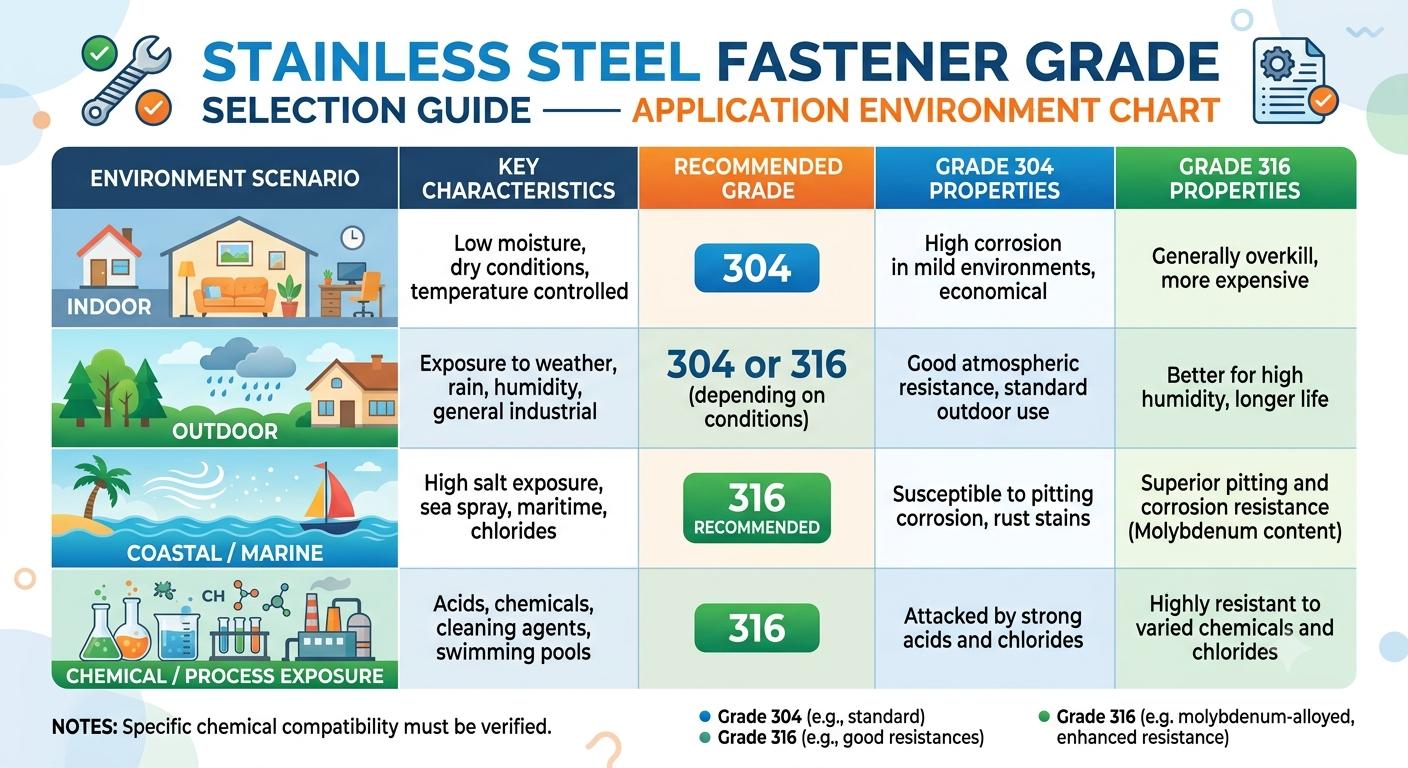
The 304 vs 316 stainless steel screw decision becomes clearer when mapped to specific operating conditions.
Marine and Coastal Environments. Salt-laden air and seawater create the most demanding conditions. 316 stainless steel screws are the industry-standard choice here. 304 fasteners in coastal atmospheres can develop surface rust within months — from free iron particles on thread surfaces reacting with chlorides, not from the base metal corroding. For dockside hardware, offshore platforms, and waterfront cladding, 316 is non-negotiable.
Chemical Processing and Industrial Facilities. Fasteners exposed to acids, caustic agents, or chloride-bearing process fluids require 316. The molybdenum resists intergranular corrosion that propagates along grain boundaries in 304 under sustained chemical attack. Mild exposure — infrequent washdowns with diluted cleaners — may accept 304, but any continuous chemical contact favors 316.
Outdoor Urban, Rural, and Inland Construction. 304 stainless steel screws are typically adequate. Rain, humidity, and mild pollutants do not attack 304 at a rate that compromises structural integrity over a standard 20-to-30-year design life. With 20–40% lower cost than 316, 304 delivers better value for general outdoor fastening.
Food, Pharmaceutical, and Medical Equipment. Both grades appear in these sectors, but 316 dominates where equipment undergoes frequent CIP cycles with aggressive sanitizers or operates in high-humidity washdown zones. The added corrosion margin reduces contamination risk and extends maintenance intervals.
Cost vs. Performance: A Procurement Perspective
Unit price alone is a narrow lens. A proper 304 vs 316 stainless steel screw procurement analysis weighs material cost against exposure risk, replacement labor, and downtime cost.
For indoor warehouse shelving, 304 fasteners are the clear choice — the environment does not justify the 316 premium. For a seaside solar farm mounting structure, specifying 304 to save on upfront fastener cost risks corrosion failures within three to five years, at which point retrofit labor far exceeds the initial savings.
When in doubt, request salt spray test reports (ASTM B117 or ISO 9227) from your supplier. A reputable manufacturer provides comparative data for their 304 and 316 stainless steel screw products, giving engineers an objective basis for specification.
Summary
The 304 vs 316 stainless steel screw comparison distills to one question: what is the chloride exposure level in your application? For dry indoor and general outdoor environments — choose 304. For marine, coastal, chemical, and high-sanitation settings — choose 316. This simple rule prevents the two most common procurement errors: over-specifying costly 316 where 304 would perform, and under-specifying 304 where only 316 can survive.
As a specialized fastener manufacturer and exporter, we supply 304 (A2) and 316 (A4) stainless steel screws, bolts, nuts, and washers to wholesale buyers, distributors, and OEMs across Europe, Southeast Asia, and the Middle East. All products conform to DIN, ISO, and ANSI/ASME standards with custom dimensions, head types, and passivation finishes available. Mixed-container shipments and flexible MOQ arrangements supported.
Contact us today for a quotation or to request material certifications and salt spray test data for your next project.